
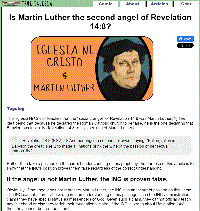
The article critiques the Iglesia Ni Cristo’s (INC) interpretation of Revelation 14:8, which identifies Martin Luther as the “second angel” declaring the fall of Babylon (interpreted as the Roman Catholic Church). The author argues that the INC’s stance on this prophecy undermines its credibility regardless of its accuracy. If Martin Luther is not the second angel, INC’s teaching is incorrect, which discredits its claim of being the true church with divine authority. If Martin Luther is the second angel, his core doctrine of justification by faith alone directly contradicts INC’s teachings, labeling them a false gospel. Therefore, the article concludes that INC’s position on this passage, whether right or wrong, invalidates its foundational claims.
God has historically used various individuals, including those outside His chosen people, for specific purposes in His overarching plan, without validating all their beliefs or actions. Figures such as Nebuchadnezzar and Balaam were utilized by God for His purposes, yet they were not aligned with His covenant or doctrine. In the case of Martin Luther, his role as the “second angel” in Revelation 14:8 was to declare the fall of Babylon, symbolizing the Catholic Church’s dominance and the beginning of religious liberty. This task did not require Luther to preach the true Gospel, as his doctrine of “faith alone” is contrary to biblical teachings. Unlike the first and third angels in Revelation 14:7-9, who directly proclaim God’s words, the second angel’s role was declarative and historical, not doctrinal. Thus, Luther’s role in religious history does not validate his theology, nor does it conflict with the INC’s teachings as the true church, which upholds biblical doctrines revealed through God’s chosen messenger, Felix Manalo.
 True Iglesia Information